Workshop services
Experts in marine mechanics and engines
Maintenance and repair of petrol and diesel engines for all types of engines: outboard, inboard and inboard-outboard engines, both petrol and diesel.
The best marine professionals for your engine. Our team of mechanics undergoes annual training at the engine manufacturers’ factories for which we are an authorised service centre.
We provide a tow truck service in the Port of Gijón and Ribadeo
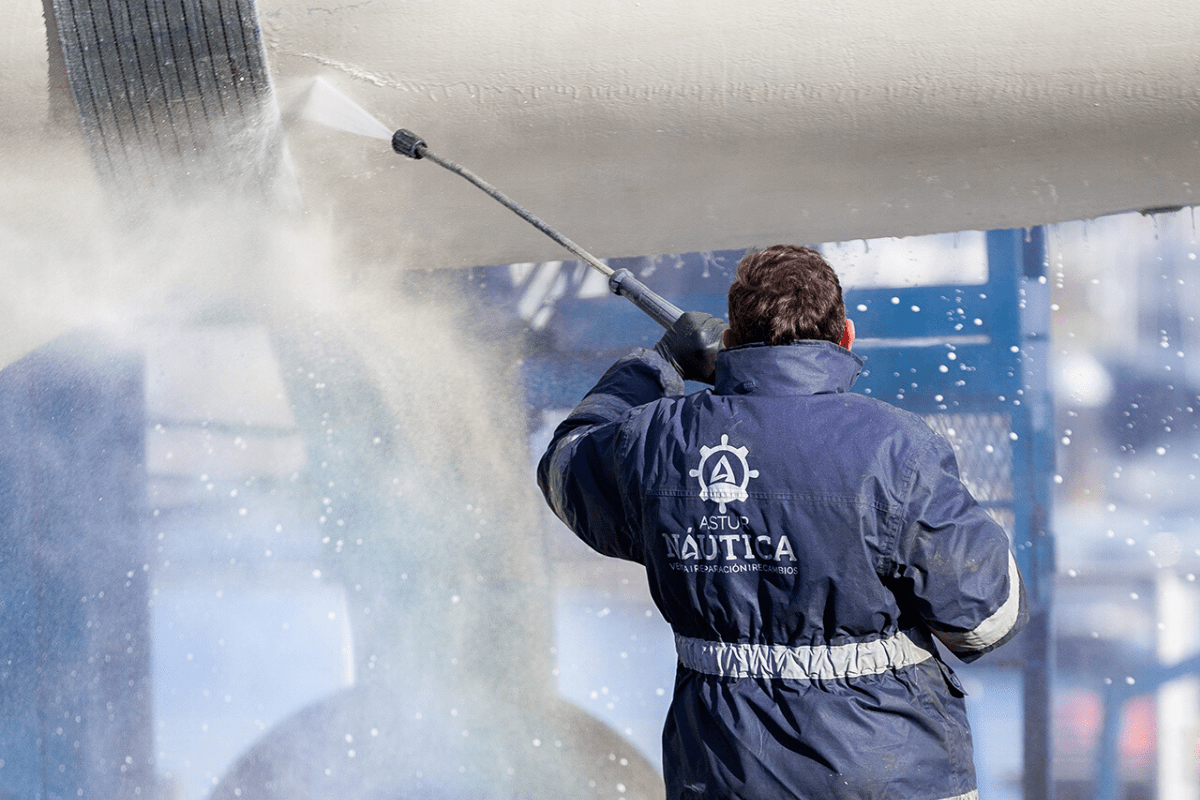
Boat maintenance services
Engine overhaul
Boat engines require maintenance at least once a year to ensure we can set sail safely and without fear of engine failure. By carrying out regular engine servicing, we can ensure optimal performance and extend the engine’s lifespan, resulting in fewer repairs in the future and, consequently, savings on future repair costs.
Our maintenance services range from engine oil changes, oil filter replacement, fuel filter and pre-filter replacement, engine anode replacement or timing belt replacement, right through to a complete engine overhaul of the boat.
At Astur-Náutica, we carry out all the necessary marine engine maintenance and repairs to keep your boat in top condition, whatever type of engine your boat has: outboard, inboard or stern drive.
Repair of seawater pumps and replacement of turbines
Seawater pumps are designed to draw in seawater and force it through the engine to cool it down.
Some pumps are fitted at the stern, whilst others are located in the engine compartment. The impeller inside the pump is made of rubber and is responsible for forcing the water through the engine, but it needs to be replaced from time to time due to wear caused by friction. On some occasions, when the pump is badly damaged, it needs to be completely rebuilt, involving the replacement of seals, bearings, the main shaft or the pump
housing. At Artur-Náutica, we offer a full service for the repair of seawater pumps and the replacement of impellers.
Cleaning of all engine coolers
Coolers are components fitted to engines to cool two fluids that flow through them. One of the fluids is always the cooler seawater, which exchanges heat in an open circuit with another fluid—such as engine oil, fuel, hydraulic oil, antifreeze, etc.
Over time and with engine hours, deposits of salt, limescale or barnacles build up inside the tubes, blocking the flow, reducing the flow of cold water and causing poor cooling. This can lead to the engine overheating, causing it to operate in sub-optimal conditions and resulting in increased wear or even more serious breakdowns. Keeping the cooling system in good condition is vital to avoid more costly repairs.
Replace the tail bellows
The stern bellows are made of rubber and serve to seal the hull, preventing water from entering. Transom bellows are only found on boats fitted with inboard-outboard engines and are fitted between the transom and the stern.
They are essential components that should be replaced to prevent water ingress.
Ensuring the hull is watertight is vital for safe sailing, but many people do not keep up with this maintenance.
Ask us for an assessment of the condition of your boat’s transom bellows
Replacement of bottom valves and through-hull fittings
Seacocks are shut-off valves found on boats at every water inlet, such as in toilets, sinks, engine cooling systems and showers.
As these components are located below the waterline, seacocks and through-hull fittings are subject to constant and greater wear and tear than other parts due to the salty and humid conditions in which they operate.
They must be inspected annually as they are subject to corrosion from seawater; if they ever fail or fail to close, water will flood the interior unchecked, potentially causing the boat to sink.
Replacement of horns/cable glands
The stern tube is the connection between the propeller and the engine. It is a tube that houses the stuffing boxes and the propeller shaft. In other words, it is the passage through which the propeller shaft passes through the hull of the vessel.
The stuffing boxes, in turn, form the system designed to prevent water from entering through the stern tube. They prevent water from entering via the propeller shaft.
There are various types of stuffing box and, due to the friction and heat they are subjected to during operation, it is important to keep them in good condition to ensure the hull remains watertight.
Please contact us if you have any questions
This is how we work
See what our customers’ boats look like after they’ve been through the Asturnáutica workshop.